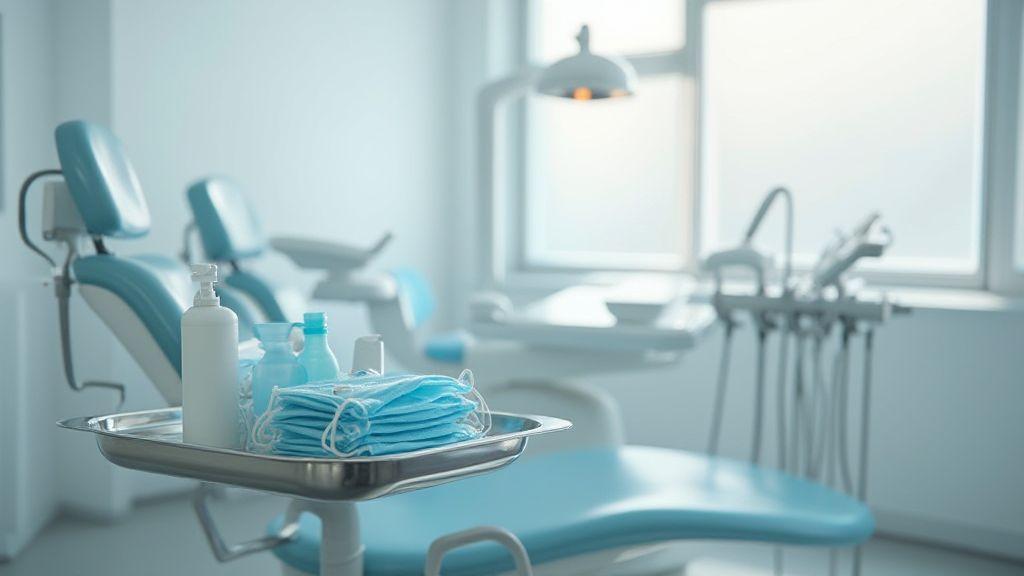
Cleaning a medical or dental office is a different discipline from cleaning an office. The organizing idea is the split between clinical contact surfaces and housekeeping surfaces — and getting that split right determines everything else: which product is used, in what order, by whom, and how it is documented.
Below is the checklist by area and frequency, the distinction that drives it, and where the actual governing standards live.
This is general operational guidance for facility and practice managers, not compliance advice. Your practice’s infection control coordinator, the CDC’s guidance for your setting, OSHA’s Bloodborne Pathogens Standard (29 CFR 1910.1030), your state dental or medical board, and each product’s own label instructions govern what you must do. Where this page and any of those disagree, they win.
The distinction everything else follows from
The CDC separates environmental surfaces in clinical settings into two categories, and they are cleaned differently:
- Clinical contact surfaces — touched during patient care or contaminated by spatter and aerosols. Light handles, chair switches and controls, x-ray equipment, countertops next to the chair, drawer and cabinet handles, computer peripherals in the operatory, faucet handles. These require an EPA-registered hospital disinfectant, applied for the full contact time printed on the label.
- Housekeeping surfaces — floors, walls, sinks outside the operatory, and general fixtures. Lower risk. Cleaned with detergent and water on a routine schedule, with disinfectant used when visibly soiled or after a spill.
Two things go wrong most often in practice. The first is treating a clinical contact surface as a housekeeping surface, usually because it sits just outside the operatory. The second is ignoring contact time — spraying a disinfectant and wiping it away in fifteen seconds when the label calls for several minutes of visible wetness. A disinfectant wiped dry early has not disinfected anything, and the surface will look perfectly clean.
Clean first, then disinfect
These are two steps, not one. Cleaning removes soil and organic material; disinfection kills what remains. Disinfectant applied over visible soil is blocked by that soil and does not reach the surface. In practice this means the two-step wipe: one pass to clean, a second to disinfect and leave wet for the labeled contact time.
Operatory checklist: between every patient
This is clinical staff’s responsibility during the day, not the cleaning crew’s. It is included here because it defines what the end-of-day clean is building on.
- Remove and discard single-use barriers
- Clean, then disinfect all clinical contact surfaces, observing full contact time
- Chair, headrest, armrests, and control switches
- Light handles and the light switch
- Delivery unit, hoses, and syringe handles
- Bracket table and adjacent countertop
- X-ray unit head, controls, and sensor holders
- Replace barriers before the next patient
End-of-day checklist: clinical areas
Operatories and exam rooms
- Full clean and disinfect of all clinical contact surfaces
- Wipe the chair base, foot controls, and the floor area immediately around the chair
- Clean and disinfect sinks and faucet handles
- Empty and disinfect waste containers; replace liners
- Confirm sharps containers are below the fill line and not overfilled
- Wipe cabinet fronts, handles, and drawer pulls
- Disinfect light switches, door handles, and door push plates
- Mop hard floors with a fresh solution; use a dedicated mop head for clinical areas that is never used elsewhere
Sterilization and lab area
- Clean and disinfect all counter surfaces, keeping the dirty-to-clean workflow direction intact
- Clean and disinfect the ultrasonic unit exterior and the sink
- Wipe the autoclave exterior
- Empty waste; replace liners
- Mop floors last, moving from the clean end toward the dirty end
Cross-contamination control
- Color-coded microfiber, with a dedicated color per zone: operatory, restroom, general. Cloths never cross zones.
- One cloth per surface area, folded to expose fresh faces; never returned to the solution after use.
- Separate mop heads for clinical areas, restrooms, and general space.
- Clean to dirty, always. Clean areas are cleaned before contaminated ones, never the reverse.
- Gloves changed between zones, and hand hygiene between glove changes.
Non-clinical areas
Reception and waiting room, daily
- Disinfect all seating, including armrests, which are the single most-touched surface in the room
- Disinfect door handles, push plates, check-in kiosk or tablet, pens, and the front desk counter
- Clean glass partitions and entry glass
- Empty trash
- Vacuum carpet and traffic areas; mop hard floors
- Wipe children’s play surfaces and toys if the practice keeps them
Restrooms, daily
- Clean and disinfect toilets inside and out, including the base and the floor behind
- Sinks, counters, faucet handles, and soap dispensers
- Mirrors
- Restock paper goods and soap
- Empty waste and sanitary bins
- Disinfect door handles, latches, and dispenser buttons
- Disinfect floors, corners, and behind fixtures
Staff break room and offices, daily
- Counters, tables, and chair surfaces
- Sink, appliance exteriors, microwave interior
- Trash and food waste removed from the building
- Disinfect shared keyboards, phones, and light switches
- Vacuum and mop
Weekly, monthly and periodic
Weekly
- Full dusting of horizontal surfaces in non-clinical areas
- Interior glass and partitions cleaned completely
- Baseboards in clinical corridors
- Wipe walls around switches, handles, and chair-height contact points
- Detail vacuum under and behind reception furniture
- Clean and disinfect entry mats
Monthly
- High dusting: vents, light fixtures, tops of cabinets, door frames
- Interior windows, sills, and tracks
- Blinds wiped
- Upholstered waiting room furniture vacuumed thoroughly
- Refrigerator interior cleaned
- Detail clean behind movable equipment
Quarterly and annually
- Carpet extraction, two to four times per year
- Hard floor scrub and recoat; strip and refinish annually
- Deep clean of restroom grout and drains
- HVAC filter replacement on the building’s schedule
- Exterior windows
These periodic services sit outside the recurring contract and are quoted separately. Costs are broken down in our guide to commercial cleaning cost per square foot, where medical and healthcare facilities run $0.14 to $0.28 per square foot against $0.09 to $0.20 for general office.
Terminal cleaning
In hospital settings, terminal cleaning means the complete clean and disinfection of a room after a patient is discharged or transferred, before the next patient occupies it — everything cleaned top to bottom, all high-touch surfaces disinfected, all disposables replaced.
Most dental and outpatient medical practices do not perform terminal cleaning in the hospital sense. The equivalent is the end-of-day clean above, combined with the between-patient operatory protocol. Where a practice does need true terminal cleaning is after an isolation case or an incident involving significant contamination, and the procedure for that should come from the practice’s own infection control plan, not from a general checklist.
What to require from a cleaning vendor
- Written scope split by surface category — clinical contact versus housekeeping. A vendor who does not use that distinction has not worked in clinical settings.
- Named products with EPA registration numbers, and staff who know the contact time for each.
- Color-coded equipment and a documented zone system.
- Background-checked staff. They work unsupervised around patient records.
- Bloodborne pathogens training for anyone entering clinical areas, and documentation of it.
- Licensing, insurance, and workers’ compensation — certificate, not assurance.
- After-hours scheduling that fits your patient day.
- Cleaning logs you can produce during an inspection.
Frequently asked questions
What is included in medical office cleaning?
Medical office cleaning covers daily disinfection of clinical contact surfaces, exam room and operatory cleaning, sterilization area, restrooms, reception and waiting areas, staff spaces, and floors, using EPA-registered hospital disinfectants applied for their full labeled contact time, with color-coded equipment to prevent cross-contamination.
What is the difference between a clinical contact surface and a housekeeping surface?
Clinical contact surfaces are touched during patient care or contaminated by spatter, such as light handles, chair controls, and adjacent counters; they require an EPA-registered hospital disinfectant at full contact time. Housekeeping surfaces such as floors and walls are lower risk and are cleaned with detergent and water on a routine schedule.
How often should a dental office be cleaned?
Clinical contact surfaces are cleaned and disinfected between every patient by clinical staff. A full professional clean of the practice should be performed daily, five days a week, with weekly, monthly, and quarterly tasks layered on top.
What is terminal cleaning?
Terminal cleaning is the complete clean and disinfection of a room after a patient is discharged or transferred, before the next patient occupies it. It is a hospital practice; most outpatient dental and medical offices use an end-of-day clean plus a between-patient operatory protocol instead.
Why does contact time matter so much?
An EPA-registered disinfectant only works if the surface stays visibly wet for the full time printed on its label, often several minutes. Wiping it dry early means the surface was cleaned but not disinfected, and it will look identical either way.
Does medical office cleaning cost more than regular office cleaning?
Yes. Medical and healthcare facilities typically run $0.14 to $0.28 per square foot against $0.09 to $0.20 for general office space, reflecting disinfection protocols, regulated waste handling, trained staff, and documentation.
Medical and dental office cleaning in Monmouth County
Maison Mop Stars cleans medical and dental offices, med spas, and aesthetic clinics across Monmouth County, New Jersey, with background-checked crews and after-hours scheduling built around the patient day.
See our medical and dental office cleaning page, our general office cleaning checklist, or commercial cleaning services.
Request a free walkthrough and written estimate, or call and text (732) 268-0803.